Constructive and Joint Liability
Constructive Liability is not explicitly defined under Indian penal code, but it closely related to the concept of Joint Liability, Common Intention (Sec 34 IPC) and Common Object (Sec 149 IPC).
Introduction
Generally, In Indian penal code, a person can be held liable for the offence he committed but Constructive Liability creates legal fiction so that the person may be held liable for the acts of others even if he does not directly participate in the act.
Constructive Liability is not explicitly defined under Indian penal code, but it closely related to the concept of Joint Liability, Common Intention (Sec 34 IPC) and Common Object (Sec 149 IPC).
Constructive Liability or Joint liability under Indian penal code
Joint Liability is a broader concept than Constructive Liability includes both civil and criminal aspects whereas Constructive Liability is the subset of joint liability. Constructive Liability means that the person may be held liable for the offence committed by another person due to shared intent, prior arrangement and meeting of mind or group conduct. On the other hand, Joint liability means that liability shared collectively among two or more persons for a Criminal act committed in furtherance of shared intention or plan.
Key Provisions in Indian penal code
1. Common Intention (Section 34 IPC)::- This section deals with cases where a criminal act is done by several persons in furtherance of the common intention. Each of such person will be held liable for the act in the same manner as if they alone committed it.
Key Ingredients:
- Criminal Act by several persons
- Sharing Common intention
- Participation in the act
- Pre-arranged plan (not always necessarily premeditated)
Example: A holds the victim down and B stabs him, both A and B are liable for murder.
Case Law: Barendra Kumar Ghosh Vs King Emperor (1925)
Held: “Even a person standing outside and encouraging the offence can be held equally liable.”
Case Law: Mahbub Shah Vs Emperor (1945)
Held: Common intention requires a prior meeting of minds.
2. Common Object (Section 149 IPC)::- Section 149 holds every member of an unlawful assembly liable for any offence committed in prosecution of the common object of that assembly.
Key Ingredients:
- Unlawful assembly (5 or more persons)
- Common object
- No need of a prior plan
- Commission of an offence by any member
Example: Six people go to beat up a man, and one of them stabs him to death. All are liable under section 149 IPC.
Case Law: Case: Lalji v. State of U.P. (1989)
Held: It was held that mere membership in an unlawful assembly is sufficient for conviction if an offence is committed in prosecution of the common object.
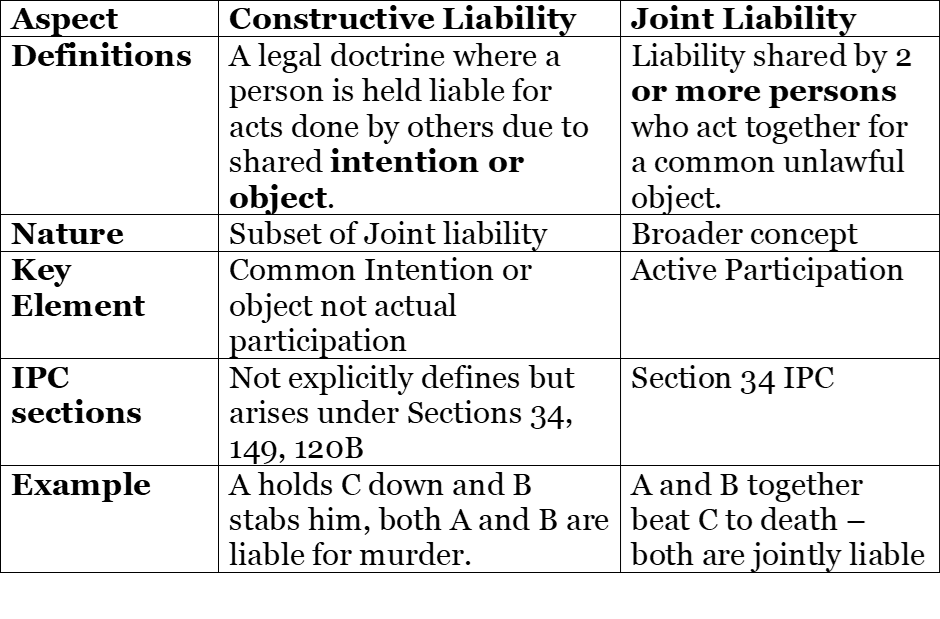
Difference Between Constructive and Joint Liability (IPC)
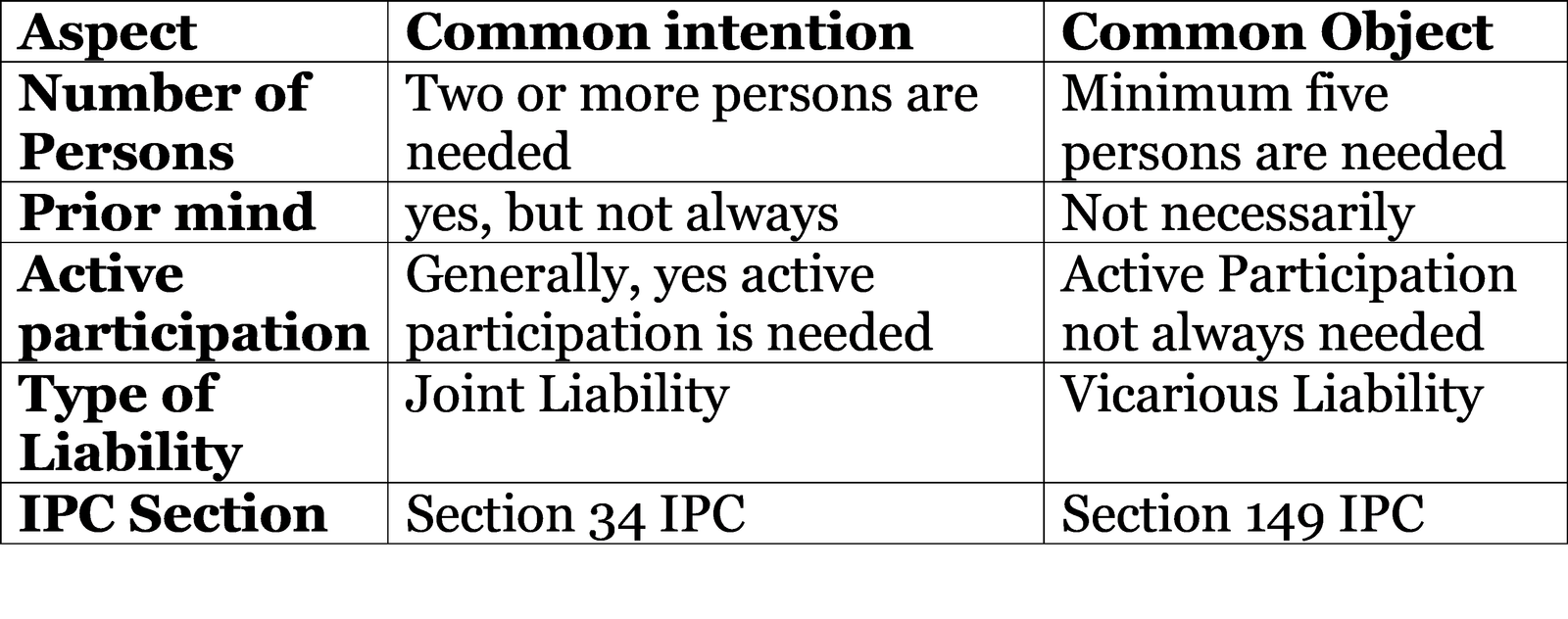
Difference Between Common Intention and Common Object (IPC)
Conclusion
In criminal jurisprudence, liability is typically personal, but the law recognizes circumstances where individuals can be held liable for acts not physically committed by them. Constructive and joint liability doctrine emerges from this need. These Doctrines ensures that no individual escapes punishment by blaming each other. Sections 34 and 149 IPC act as strong deterrents against group crime, upholding the principle that criminal responsibility can be collective when the intention or object is shared. They ensure that justice is not defeated by the complexity of group dynamics, and that every member of a wrongful act is held accountable, either by their deed, their intention, or their association.